Haiti’s Most Dangerous Natural Hazards - Mass Extinction
Considering
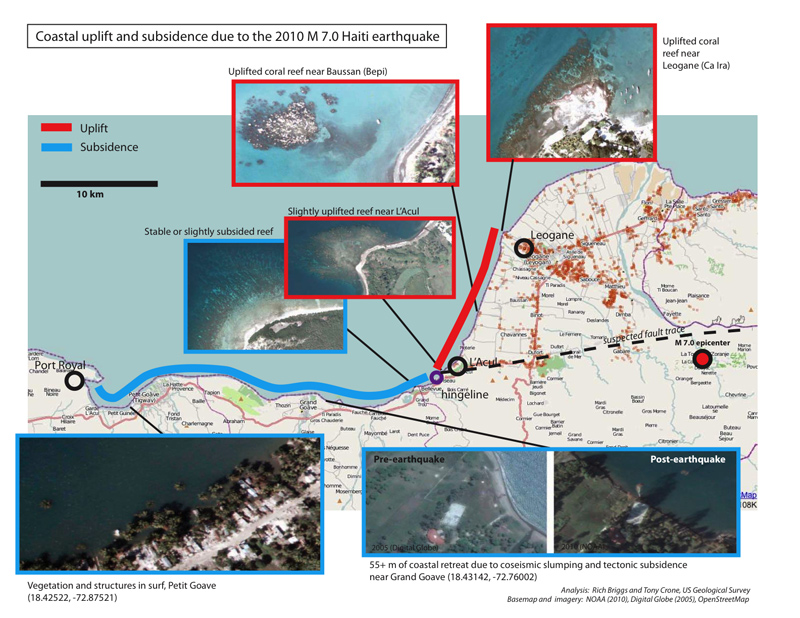
rates of occurrence, severity, damage sustained, earthquakes - nearly one quarter
of one million people were lost to the human population in the 2010Quake -
would have to win the top position for Haiti’s most dangerous hazard. But, the
all-time winner and my personal favorite
for cross-species mass extinction are volcanoes.
Although Haiti lies in the islands known as the Greater Antilles, very close by
on the same Caribbean plate, lies “The Lesser
Antilles Volcanic Arc which forms the eastern boundary of the Caribbean
plate. It is part of a subduction
zone, also known as the Lesser Antilles subduction zone,
where the oceanic crust of the South American Plate is being
sub-ducted under the Caribbean Plate. The Lesser Antilles Volcanic Arc includes
seventeen active volcanoes - Soufriere Hills on Montserrat;
Mount Pelée
on Martinique;
La Grande Soufrière on Guadeloupe;
Saint Vincent on Saint Vincent; and the submarine
volcano Kick 'em Jenny which lies about 10 km
north of Grenada.”
Remember Mount Pele? It destroyed a town of thirty-thousand within minutes of
eruption in 1902. Mount Pele
Why do these natural hazards happen?
Earthquakes are usually caused
when tectonic plates shift in a sudden release of energy called seismic waves
which shake the Earth. Continental plates at convergence are rocks pushing against
each other, lacking space to move, the rocks eventually break under pressure,
this breaking point is the focus and the same point above ground the
epicenter. Earthquakes
How are plate tectonics and volcanoes closely interrelated? Visit USGS on the connection between
plate tectonic theory and plate and inter-plate volcanoes.
Terrestrial Causes of Mass Extinction Moving continents - when
all land masses on Earth combine, the global diversity will be lower (long
route) Globally low sea-level – cool climate, global volcanism (short route) Recommendations to address the natural hazards - mitigation. Perhaps the best mitigation is an Early Warning System for both Earthquakes and Volcanoes, but especially volcanoes are difficult to predict. People live in and visit the Caribbean for the natural beauty which abounds there. People are connected in their hearts to the land or for urbanites, the cities in which they live, and are quite loyal to the places in which they live. It might be difficult to convince people to move away from these gorgeous islands of the Lesser and Greater Antilles, because of a future geological hazard, such as a volcanoe due for eruption, or perhaps even because they have survived an incident as great as the quake. The most risky areas are the fault zones and it would be safe not build even your steel frame construction within five miles either way of the Enriquillo-Plantain Garden Fault (EPGFZ), nor near the Septentrional-Orient Fault Zone (SOFZ), away from the hazards of the coastline, mass wasting, nor any of the thousands of square miles of deforested land, as during the Hurricane season, this will all flood, and your house will wash away. The best place to be would be in the National Forests, but not on a subterranean cave opening - on relatively high ground on solid rock formation. Bring your own cooking fuel, and be brave!